
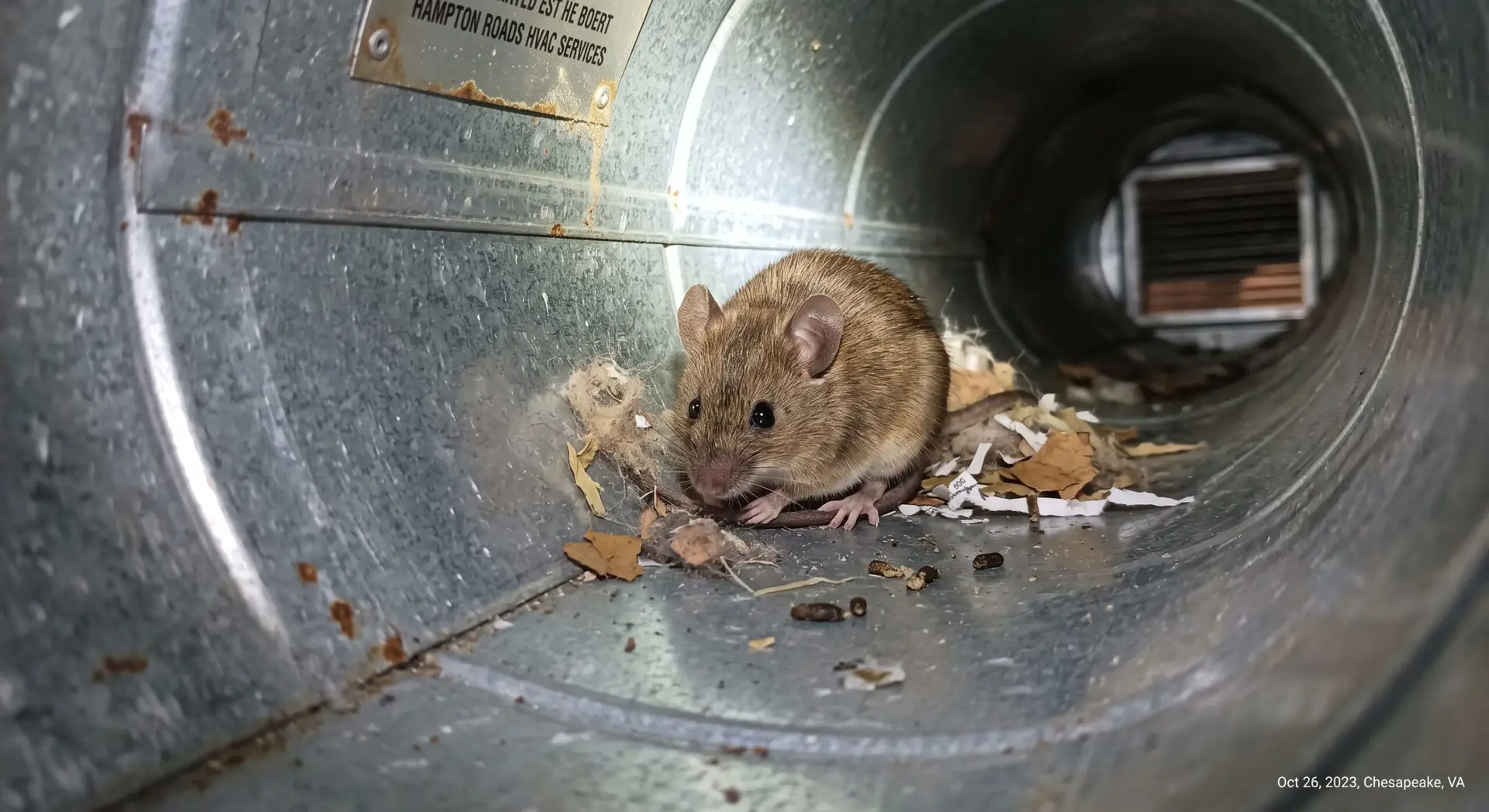
If you live in Chesapeake, you know how much we rely on our central heating and air conditioning to get us through humid summers and chilly winters. But what happens when your home’s air distribution system becomes a highway for unwanted guests?
Rodents—specifically mice and rats—are incredibly adept at finding their way into residential air ducts. Because your ductwork runs through hidden areas like crawl spaces, attics, and interior walls, it provides the perfect, protected path for pests to navigate your entire home.
If you’ve noticed strange noises or a lingering odor when your HVAC kicks on, you might be dealing with an air duct infestation.
How Rodents Get Inside Chesapeake Ductwork
Central HVAC systems are closed loops, but they aren’t completely impenetrable. Over time, your home shifts, materials degrade, and pests take advantage of the smallest vulnerabilities to gain access:
- Tears in Flexible Ductwork: Many homes in Chesapeake utilize flexible ductwork (flex ducts) in attics and crawl spaces. These ducts consist of a thin plastic outer lining, fiberglass insulation, and a wire-supported inner core. To a rat or mouse, this material is incredibly easy to chew through.
- Loose Connections and Gaps: As duct sections age, the tape or mastic sealing the joints can dry out and fail. Rodents can easily squeeze through a gap as small as a dime to pull themselves inside the airflow stream.
- Unsealed Register Boots: The metal boxes (boots) that connect your ductwork to the vents in your floors or ceilings often have gaps around them where they pass through the drywall or subfloor. Rodents follow these gaps directly into the system.
The Consequences of a Ductwork Infestation
When rodents move into your air ducts, the issues go far beyond the unsettling sounds of scratching inside your walls. It poses immediate risks to your property and your family’s health:
Major Energy Loss
When rats tear open your flex ducts to build nests, conditioned air escapes directly into your crawl space or attic. Your HVAC system has to work twice as hard to maintain your indoor temperature, causing your Chesapeake energy bills to skyrocket.
Severely Compromised Indoor Air Quality
Every time your system turns on, air is forced over rodent droppings, urine, shed fur, and nesting materials. This blows microscopic particles, airborne bacteria, and allergens straight into your living areas, frequently triggering asthma attacks, unexplained allergies, and sinus issues.
The Solution: A Two-Pronged Approach
Completely resolving a rodent issue in your HVAC system requires specialized care. Standard pest control traps will not repair the structural damage left behind, and a simple patch job won’t clean out the contamination.
To permanently restore your home, you need a coordinated effort:
- System Decontamination and Repair: Companies like Universal Duct Cleaning specialize in thoroughly cleaning out the physical debris, sanitizing the internal surfaces of your system to eliminate airborne pathogens, and replacing or sealing damaged metal and flex ducts.
- Attic and Crawl Space Restoration: Because rodents usually enter the ducts from the surrounding structural voids, companies like Universal Insulation Doctor focus on fixing the root environment. They specialize in removing soiled insulation, sanitizing attic or crawl space areas, and performing professional exclusion work to seal the external entry points so pests can never get back into your home’s envelope.
Frequently Asked Questions
1. How do I know if rodents are actually inside my air ducts?
The most common signs include a distinct, stale, or musty odor when your heating or cooling system turns on, faint scratching or scurrying sounds coming from the walls or ceilings, and unexplained drops in airflow to specific rooms. In severe cases, you may even see small bits of insulation or dark droppings near your floor registers.
2. Can I just spray disinfectant or use traps in my vents myself?
No. You should never spray household disinfectants or chemical pesticides directly into your registers, as your system will distribute those toxic fumes into your breathing air. Furthermore, standard DIY traps placed inside vents rarely solve the issue because the root entries and structural damage exist in hidden areas like the crawl space or attic.
3. Will cleaning the ducts also fix the hole where they got in?
Duct cleaning removes the contamination, but it must be paired with physical repairs and environmental exclusion. Professional duct technicians will seal the holes within the HVAC system itself, but a specialist is required to seal the exterior foundation and attic gaps to prevent a repeat infestation.