Every spring we get the same phone call: a homeowner is standing over a pile of winged insects on a windowsill, trying to decide whether this is a nuisance or a five-figure problem. You can settle it yourself in about thirty seconds, with no equipment, if you know which three features to look at.
How do I tell a flying ant from a termite swarmer?
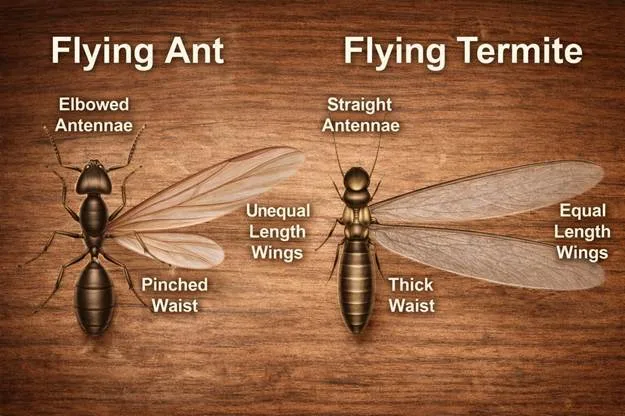
Check three features: antennae, waist, and wings. A termite swarmer has straight beaded antennae, a broad uniform body with no pinched waist, and four wings of equal length. A flying ant has elbowed antennae, a sharply narrowed waist, and front wings noticeably longer than the back pair.
Colour is the one thing people reach for first and the one thing that will mislead you. Both insects are commonly dark, and there are pale ants and dark termites. Ignore colour entirely and use the structure.
| Feature | Termite swarmer | Flying ant |
|---|---|---|
| Antennae | Straight, resembling a tiny string of beads | Bent at a distinct elbow |
| Waist | Broad and uniform — the body looks like one continuous tube | Sharply pinched, an obvious narrow segment |
| Wings | Four wings, all the same length, much longer than the body | Front pair clearly longer than the rear pair |
| Wings after landing | Shed easily — piles of detached wings are the classic sign | Usually stay attached |
| Body outline | Straight-sided | Three distinct segments |
What do discarded wings on a windowsill mean?
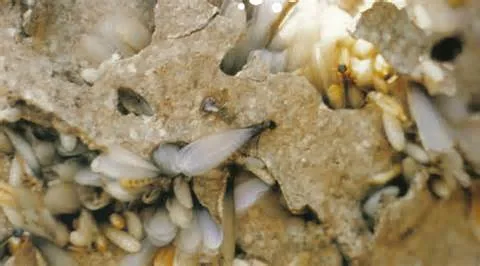
A scatter of detached, equal-length wings on a sill, in a bathtub, or along a baseboard is one of the strongest indicators of subterranean termites. Swarmers shed their wings shortly after emerging, and they collect wherever the insects were drawn to light.
The wings matter more than the insects themselves. Swarmers are poor fliers, and many die quickly indoors — but the wings persist, which means you may find the evidence days after the swarm. Vacuuming them up before anyone can identify them is the most common mistake we see.
Why does a swarm indoors mean more than one outdoors?
Swarmers emerging inside your home indicate a mature colony that is already established in or under the structure. A swarm outdoors in the yard shows termites are active nearby, which in Hampton Roads is close to a baseline condition.
- Indoors, near a window or light fixture. Treat as urgent. Colonies generally take years to reach the point of producing swarmers, so this points to established activity, not a new arrival.
- Outdoors, from a stump, mulch bed, or landscape timber. Common, and not by itself evidence your house is infested — though it is a good reason to book an inspection and check conducive conditions near the foundation.
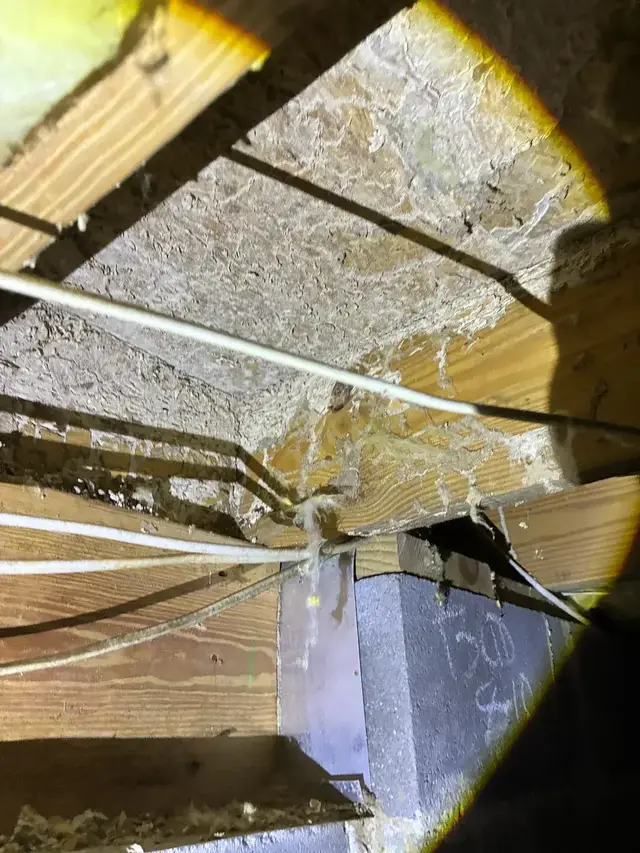
- From a crawl space vent or the base of a foundation wall. Worth investigating promptly. Look for mud shelter tubes on the foundation.
When do termites swarm in Hampton Roads?
Eastern subterranean termites, the species that infests homes throughout coastal Virginia, typically swarm in spring on warm days — frequently after rain, and usually during daylight hours. Ants swarm across a broader stretch of the warm season.
Two local details are worth knowing. First, the daytime timing is itself a clue: our subterranean termite swarms are a daylight event, so a large evening emergence around outdoor lighting is more likely to be ants. Second, swarms tend to appear first on the warm side of the house — south- and west-facing walls, sunny foundation corners, and rooms above a heated crawl space warm up sooner.
Mild coastal winters mean colony activity here does not shut down the way it does further inland, which is why we find fresh mud tubes on foundations in months when homeowners assume termites are dormant.
What should I do in the first 24 hours?
Collect a sample and photograph the location before cleaning anything up. Do not spray the swarm — over-the-counter aerosols kill the visible insects, scatter the rest, and destroy the evidence needed to identify the source.
- Capture several specimens. Press clear tape over a few insects, or seal them in a bag or jar. Include wings if the bodies are gone.
- Photograph where they appeared. Which window, which room, which side of the house. That location narrows down where the colony is reaching the structure.
- Leave the wings in place if you can. Their distribution tells an inspector a great deal.
- Skip the hardware-store spray. It does nothing to a colony living in soil or inside wood, and repellent products can push foragers to a different part of the structure.
- Check the foundation for mud tubes. Pencil-width earthen tubes running up the foundation wall, pier, or crawl space framing are the transit routes subterranean termites build.
- Book an inspection. Bring the sample. Identification takes minutes.
If it turns out to be ants, does it still matter?
Sometimes yes. Carpenter ants do not eat wood, but they excavate galleries in it to nest — and they prefer wood that is already damp or decayed, which points back at a moisture problem.
A carpenter ant swarm indoors often means there is softened wood somewhere in the structure: a crawl space with high humidity, a leak behind a wall, or a decaying sill. In that case the ants are a symptom worth reading. The relevant follow-up is a crawl space inspection and, where decay is found, wood fungus treatment. Most other flying ants are a seasonal nuisance and nothing more.
Frequently asked questions
Do swarmers bite or sting?
Termite swarmers do neither, and they do not damage anything themselves — their only job is to start new colonies. Some flying ants can bite or sting, depending on species.
Can I just wait and see if they come back?
Swarming is seasonal, so the insects will disappear on their own within days regardless of whether a colony is present. Their absence is not evidence of anything, and a colony eating structural wood will keep doing so quietly all year.
What if I already vacuumed them up?
Check the vacuum canister — that is often enough to identify them. Failing that, note exactly where they appeared and have the area inspected; mud tubes, damaged wood, and other evidence do not vanish with the swarm.
Are these drywood termites?
Homes in this region are affected by Eastern subterranean termites, which nest in soil and reach the structure from below. That is why inspections concentrate on the foundation, crawl space, and soil contact points.
Where can I read more about local swarm season?
We have covered the seasonal side in Swarming Termites in Hampton Roads: What Should You Do? and Flying Termites or Flying Ants.
How do I get a positive identification?
Bring us the sample. Universal Pest & Termite provides free termite inspections across Virginia Beach, Chesapeake, Norfolk, Suffolk, Portsmouth, Hampton, Newport News, Williamsburg, Poquoson, and York County. Call (757) 502-0200, and see termite treatment for what happens if the answer is termites.