Suffolk is the largest city in Virginia by land, and most of that land is not lawn. Peanut fields, timber tracts and swamp margin surround everything the city has built, from the brick blocks of downtown out to the new cul-de-sacs of Harbour View. The pest bill in Suffolk splits along that same line: rural properties fight what walks in from open ground, while the newer suburbs fight what moved in when the ground was cleared. Below are the 2026 numbers, and how the two halves of the city spend them differently.
How much does pest control cost in Suffolk in 2026?
Ongoing protection is $38 per month for Essential quarterly pest service, or $63 per month for Pro with termite coverage. Duct and dryer-vent cleaning remain available as separate jobs, each quoted on its own scope. By-the-job pricing: $87 to $287 for a one-time call, $395 for a liquid treatment confined to one area, $595 to $1,195 for a full trenched barrier, $99 to $1,495 to seal a home against rodents, $75 to $125 for a closing letter, and $3,000 to $10,000 for crawl space encapsulation. Quarterly plans across the area are more often quoted at $40 to $70 per month. Market ranges reflect what we typically see other Hampton Roads companies charge, based on quotes homeowners bring us. They are our own observations, not a published survey. The flat termite treatment prices assume a qualifying home, which the inspection establishes first.
Market ranges reflect what we typically see other Hampton Roads companies charge, based on quotes homeowners bring us. They are our own observations, not a published survey. Everything of ours above is a floor or a span; the exact figure waits on an inspection.
Plan tiers are laid out on the home health plans page, and the citywide service roster lives on the Suffolk pest control page.
Rural Suffolk and suburban Suffolk: why do their bills look different?
Open ground decides it. South and west of downtown, homes border fields and timber, so the spend goes to what crosses the property line each season — field mice at first frost, fire ants in the sun, wildlife in the outbuildings. North of the river, the newer subdivisions built on cleared farmland inherit the displaced pests plus a construction-gap problem no builder's warranty covers.
What does the farmland edge send at a house each year?
A calendar's worth of arrivals. Around Holland, Whaleyville and Cypress Chapel, harvest strips the cover from hundreds of acres at once, and the field mice that lived in it head for the nearest heated structure inside a few cold nights. Summer belongs to fire ant mounds along driveways and sunny fence lines, and to ticks wherever mowed yard meets tall grass. None of this is a failure of the house — it is the seasonal traffic of living beside working land, and it is why rural customers lean on the quarterly plan's included revisits harder than anyone else.
Why do brand-new Harbour View homes still get invaded?
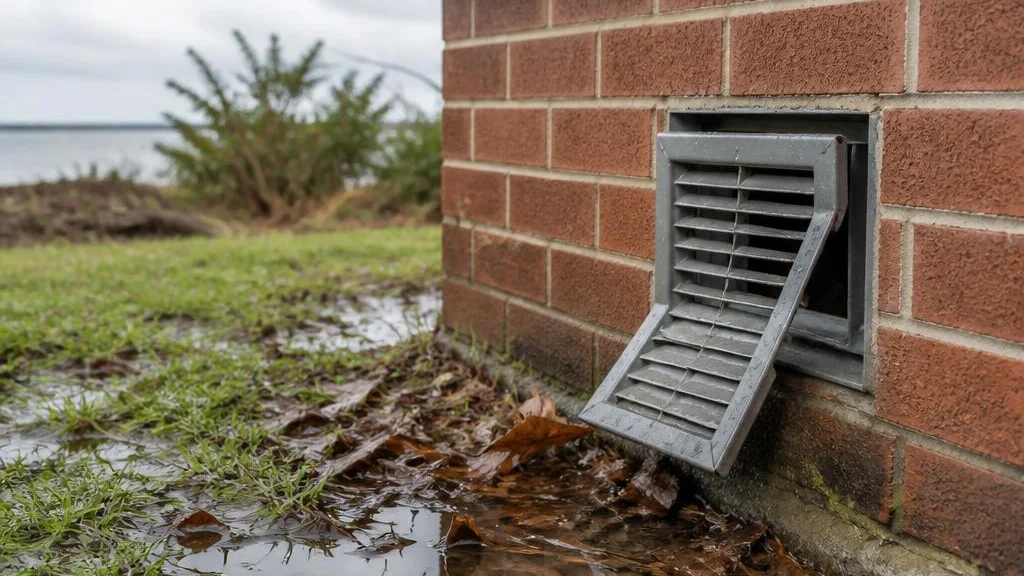
Because a new house is a fresh territory dispute. The woods and fields that stood where Harbour View and North Suffolk now sit held rodents, ants and spiders that did not leave when the framing went up — they explored it. Builders leave more openings than buyers expect: garage door sweeps that sit proud of the apron, weep holes in brick veneer, unsealed utility penetrations. A year-one exclusion pass, priced within the usual $99 to $1,495 by what the inspection finds, is cheaper than the attic cleanup that follows two winters of ignoring the scratching.
Do detached garages, barns and sheds change the quote?
They extend it. A treatment perimeter in rural Suffolk often is not one building — it is a house, a workshop, a pole barn and a well house, each with its own soil contact and its own rodent harborage. Termite work is measured by the structure it has to protect — a trenched barrier is priced as one job at $595 to $1,195, and bait stations go in at $8 to $12 per linear foot — so every added footprint adds to the number. Nothing is sold or started before an inspection, and it is the inspection that confirms which structures qualify for the published prices. The flip side: outbuildings are where infestations start quietly, and a plan that inspects them catches the colony before it crosses the yard.
How does the spending map across Suffolk?
Downtown's older blocks buy inspection-led termite and moisture work; the riverfront villages buy exclusion and mosquito control; the growth corridor buys new-construction sealing and perimeter plans; the rural south buys seasonal defense against whatever the fields rotate in.
| Area | The usual work |
|---|---|
| Downtown & Pleasure House Corner | Early-1900s foundations and long-settled crawl spaces call for termite inspection first and moisture answers second. |
| Chuckatuck, Driver & Sleepy Hole | Creekside village lots mix marsh mosquitoes with rodents working the shoreline into garages and crawls. |
| Harbour View, North Suffolk & Bennett's Creek | The growth corridor: year-one exclusion on new builds, then a standing perimeter as landscaping matures. |
| Kings Fork, Elephant Fork & Pitchkettle | Suburb-meets-field blocks where fire ant calls, tick pressure and autumn mice arrive on the same invoice. |
| Holland, Whaleyville & Cypress Chapel | Working farmland: seasonal rodent surges, outbuilding inspections and swamp-side moisture that never quite lifts. |
We also run Nansemond, Shoulders Hill, Riverview, Kilby, Everets and Concord. The follow-on work is most often rodent control, ant control, termite treatment, tick control or crawl space moisture control.
Frequently asked questions
How do your Suffolk rates stack up against other quotes I'll collect?
On the recurring side, favorably: our quarterly plan is $38 per month, where the plans homeowners show us from other companies usually price at $40 to $70 per month. Market ranges reflect what we typically see other Hampton Roads companies charge, based on quotes homeowners bring us. They are our own observations, not a published survey. On project work the honest comparison is scope, not sticker — two exclusion quotes that differ by hundreds of dollars usually differ in how many openings each company actually intends to seal, so ask both for the list.
What does getting rid of fire ants actually cost?
A visit targeting mounds falls inside the $87 to $287 one-time range, and the price tracks the size of the infested area more than the count of visible mounds — for every mound you see, the colony network below the turf is larger. Broadcast treatment of the whole sunny stretch beats poking at individual mounds, which mostly relocates them. On properties with yearly pressure, folding fire ant response into quarterly service at $38 per month costs less over a season than repeated single calls.
See ant control options in Suffolk
When should a rural homeowner book rodent work — before or after harvest?
Before. Exclusion — the sealing of vents, sills, garage edges and pipe gaps at $99 to $1,495 — works best as a closed door, not an eviction. Once the fields are cut and the first frost lands, the mice are already testing the foundation line, and work done then starts with trapping out the ones that beat you to it. Late summer is the cheap window: the house gets sealed while the pressure is still in the field.
Explore rodent control in Suffolk
Is a termite bond worth it on a house with several structures?
The more soil-contact footage you own, the stronger the case. Termite protection through the $63 per month membership covers the ongoing monitoring and treatment obligation, while one-off defenses are priced per structure — $395 for a liquid treatment where activity is confined, $595 to $1,195 for a full trenched barrier — or by the foot at $8 to $12 to set Sentricon stations. A homestead with a barn and workshop multiplies the footage; the membership turns that exposure into a flat number, which is the entire point of a bond. Our flat treatment prices assume a home that qualifies, which the inspection settles first.
See our termite protection in Suffolk
Does anyone actually need crawl space encapsulation out here?
Houses near the swamp margin are among the strongest candidates in the region. Where the ground never fully dries, an open crawl space runs humid all year, feeding termites, camel crickets and wood decay at once, and $3,000 to $10,000 spent sealing and conditioning that space buys down all three risks together. Where the crawl reads dry, we say so and the money stays in your pocket — the moisture meter, not the map, makes the call.
Book a crawl space inspection in Suffolk
Want a ballpark for your specific home?
Our cost estimator walks you through the services most Suffolk homes need and gives you a range before anyone visits.
Try the Cost Estimator →The way to turn these spans into your number is a walk-through: foundation measured, crawl space read, outbuildings included, openings counted, price quoted on the spot. It is free and there is no obligation attached — arrange a Suffolk inspection here.