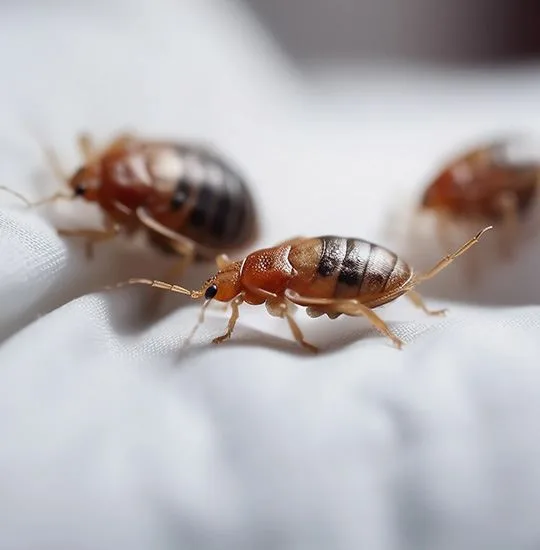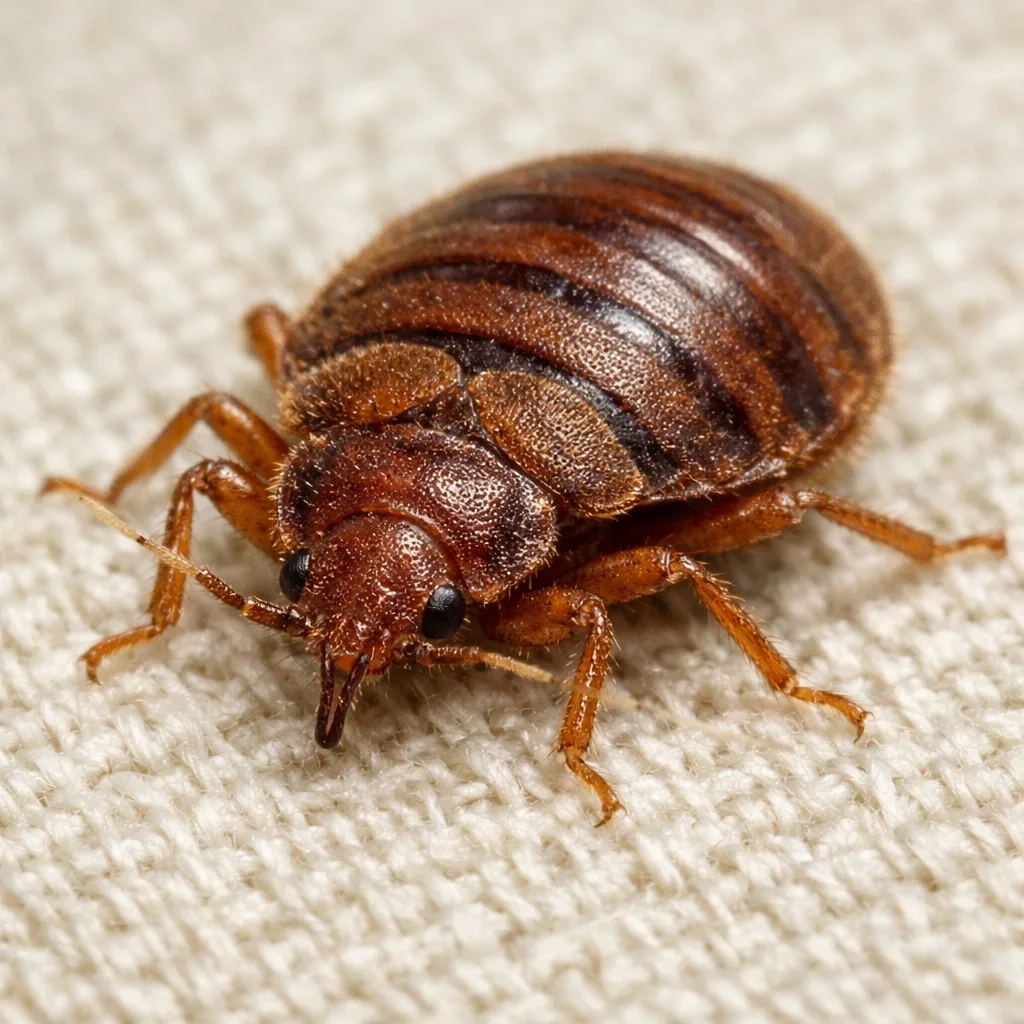
An adult bed bug looks like an apple seed that walks: about a quarter of an inch long, flat, oval, reddish-brown, with six legs, short antennae and no wings. After feeding it swells and darkens into something closer to a plump, elongated tick. Everything smaller and paler than that is a nymph, and the pearly, rice-grain-sized specks glued into a seam are the eggs.
The adult: apple-seed size, flat, reddish-brown
Hold a real adult next to an apple seed and the comparison holds up remarkably well — 4 to 5 millimetres long, broad and oval, and flattened top to bottom when it has not fed. That flatness is the point: an unfed bed bug can slide into a mattress seam, a screw hole in a bed frame or the gap behind a headboard. The body is banded, almost corrugated, across the abdomen, and it is covered in fine hairs you can see in a phone photo taken close up.
A fed bed bug looks like a different insect, which is where most misidentifications start. Blood distends the abdomen into a dark red-brown or purplish balloon, the banding stretches out, and the profile goes from flat to rounded. People who find one after it has fed often describe a tick. The difference: bed bugs have six legs and a distinct head with straight antennae, while ticks have eight legs and no antennae.
Nymphs and eggs are what people miss
A bed bug hatches at about a millimetre — the size of a poppy seed — and is translucent straw-yellow until it feeds, at which point a red spot appears inside it. There are five nymph stages, each one bigger and darker than the last, and each one leaves behind a shed skin. Those skins are pale amber, hollow and shaped exactly like the bug, and they survive long after the insect has moved on. Finding a scatter of them along a mattress seam is confirmation even when nothing is crawling.
Eggs are white, about a millimetre, and cemented in place, usually in clusters wedged into a seam, a crevice in a wooden frame or the folded edge of a box spring. They are sticky when laid and do not brush off the way lint does. Under a phone flashlight they read as tiny grains of rice with a faint pearly sheen.
The evidence is easier to spot than the insect
Bed bugs hide, so most confirmations come from what they leave behind rather than a live sighting.
| What you found | What it usually means | What to do next |
|---|---|---|
| Dark ink-dot spotting that bleeds into fabric | Digested blood — the most reliable sign of an active harborage | Check the seam, frame joint or wall junction within a few inches of it |
| Pale hollow shells in a mattress seam | Shed skins from nymphs growing through their stages | Treat as confirmation; look for live bugs deeper in the same crevice |
| Rust-coloured smears on the sheet | A bug crushed after feeding, usually by a sleeper | Inspect the bed frame and headboard the same day |
| Tiny white grains glued into a crevice | Eggs, which means breeding, not a single hitchhiker | Professional treatment; vacuuming alone will not remove cemented eggs |
| Bites in a line or cluster on exposed skin | Suggestive but never diagnostic on its own | Find physical evidence before treating anything |
| A sweet, musty odour in a closed bedroom | Associated with heavier, longer-standing infestations | Have the room inspected rather than aired out and ignored |
The look-alikes we get sent photos of
Most identification calls end with "that is not a bed bug," and it is worth knowing the usual suspects before a treatment gets bought that nobody needs. Carpet beetle larvae are the most common false alarm: small, tapered, visibly bristly, and often found in closets and along baseboards rather than in the bed. Adult carpet beetles are rounded and mottled, nothing like a flat oval.
Bat bugs are the awkward one, because they genuinely are close relatives and look nearly identical to the naked eye — the difference is the length of the hairs on the thorax, which takes magnification. They matter in older Hampton Roads homes with attic or chimney roosts, because the fix is the roost, not the bedroom. Spider beetles get mistaken for engorged bed bugs, roach nymphs for large ones, and fleas — narrow, sideways-flattened, and able to jump — are usually sorted out the moment someone watches one move.
Where to look first in a Hampton Roads home
This region moves people constantly: permanent-change-of-station moves through Norfolk, Oceana and Little Creek, base-housing turnovers, seasonal staff arriving at the Oceanfront, students settling near ODU, and week-to-week rental changeovers from Sandbridge to Chic's Beach. Bed bugs travel in luggage and furniture, so a place with constant turnover sees more introductions than a settled street does — that is the whole story, and it has nothing to do with how clean a home is.
Start at the bed and work outward in a ring. Strip the bed and check the mattress piping and both sides of the box spring, then the frame joints, screw holes and slat ends, then the headboard — particularly the back face where it meets the wall, which is a favourite in older converted apartments in Ghent, Park Place and Olde Towne where headboards get mounted to the wall. Then the nightstand drawer runners, the seam of the chair nobody sits in, the edge of the carpet at the baseboard, and any loose wallpaper or outlet plate within a few feet of the bed. Secondhand furniture and a futon frame's hinge channel deserve the same treatment before they come through the door.
If you find something, resist the urge to bug-bomb the room. Over-the-counter foggers push bed bugs deeper into voids and into adjoining rooms, which turns a one-room problem into a whole-home one. Bag the bedding for a hot wash and dryer cycle, leave the furniture where it is, and get the room inspected. Our bed bug treatment page walks through how a confirmed infestation is handled, a pest control inspection covers the case where you are not sure yet, and if you want ongoing monitoring alongside general pest coverage, that is part of our home health plans.
Frequently asked questions
How big is a bed bug, exactly?
An unfed adult is 4 to 5 millimetres long — roughly a quarter of an inch, or the size of an apple seed — and about 1.5 to 3 millimetres wide. Newly hatched nymphs are around a millimetre, closer to a poppy seed, and grow through five stages before reaching adult size. Eggs are about a millimetre and white. Nothing in the life cycle is microscopic: every stage is visible without magnification if you know where to look and have decent light.
What colour are bed bugs?
Unfed adults are a flat reddish-brown, sometimes described as mahogany. After a blood meal the abdomen distends and darkens to a deep red-brown or nearly purple, then fades back over the following days as the meal is digested. Nymphs are translucent straw-yellow until they feed, when the blood shows through as a dark red spot inside the body. Eggs and shed skins are pearly white and pale amber respectively.
Can you see bed bugs with the naked eye?
Yes. Adults and older nymphs are plainly visible; the difficulty is that they spend the day hidden in seams, joints and crevices rather than out in the open. A bright flashlight held at a low angle along a mattress seam, an old credit card to drag through the crevice, and a look at the underside of the box spring will find far more than a casual glance at the sheets. The eggs and freshly hatched nymphs are the stages that genuinely test unaided eyesight.
What is often mistaken for a bed bug?
Carpet beetle larvae are the most frequent, followed by bat bugs, spider beetles, young cockroaches, ticks and fleas. The quick checks: six legs and antennae rule out ticks; a body flattened side to side and a jump rule in fleas; visible bristles point to carpet beetle larvae; and a bug found in an attic-adjacent room of an older home with a bat or bird roost October well be a bat bug, which needs the roost dealt with rather than the bedroom.
Do bed bugs mean my house is dirty?
No. Bed bugs feed on blood, not crumbs, and they are introduced by travel and secondhand furniture rather than by housekeeping. Spotless homes, new construction and high-end hotels all get them. Clutter matters only in that it gives them more places to hide and makes treatment harder — which is why prep work before a treatment focuses on clearing and laundering rather than deep cleaning for its own sake.