In the home service industry, we know that a “one size fits all” approach leads to callbacks and frustrated customers. Managing ants in Chesapeake, Virginia Beach, and across Hampton Roads requires more than just a can of spray from a big-box store—it requires a strategic “Service-First” mindset.
Here is a breakdown of how to handle the most common local invaders while keeping your home and family safe.
1. Identify Your “Prospect”
Before you can close the door on ants, you have to know who you’re dealing with. In our region, the strategies for Odorous House Ants differ wildly from Carpenter Ants.
- Odorous House Ants: Small, dark, and they smell like rotten coconuts when crushed. They are the “high-volume” callers of the ant world—they move in fast and in large numbers.
- Carpenter Ants: Larger and capable of structural damage. They don’t eat wood, but they “excavate” it to build nests. These require a more surgical approach.
2. The “Seal the Deal” Exclusion Strategy
The best offense is a great defense. If you don’t secure the perimeter, you’re just managing a revolving door.
- Mind the Gap: Use high-quality silicone caulk to seal entry points around windows, doors, and where utility lines enter the house.
- Vegetation Management: Keep mulch at least 6–12 inches away from your foundation. Ensure tree limbs and shrubs aren’t touching the roof or siding, as these act as “highways” for ants to bypass your ground-level defenses.
- Moisture Control: Our humid Hampton Roads climate is an ant magnet. Fix leaky outdoor spigots and ensure your gutters are clear to prevent water from pooling near the crawlspace or foundation.
3. Smart Baiting vs. Blind Spraying
In sales training, we teach people to listen before they talk. In pest control, we “bait” before we spray.
Pro Tip: If you see a trail of ants, do not spray them with a contact killer immediately. You’ll kill 5% of the colony and signal the other 95% to scatter (a process called budding), which actually makes the infestation worse.
- Use Slow-Acting Baits: Place gel or station baits near the trails. The workers will take the “offering” back to the queen.
- The “Clean-Room” Rule: When baiting, do not use strong cleaners or perfumes near the bait. If the bait smells like lemon-scented bleach, the ants won’t touch it.
4. Safety-First Application
When treating your home, “safe” doesn’t mean “weak”—it means precise.
- Boric Acid Dust: This disrupts the ant’s digestive system. For maximum safety, apply this only in wall voids or behind appliances where pets and children cannot reach.
- Diatomaceous Earth: A natural powder that dehydrates insects. Always use “Food Grade” versions and wear a mask during application to avoid inhaling the fine dust.
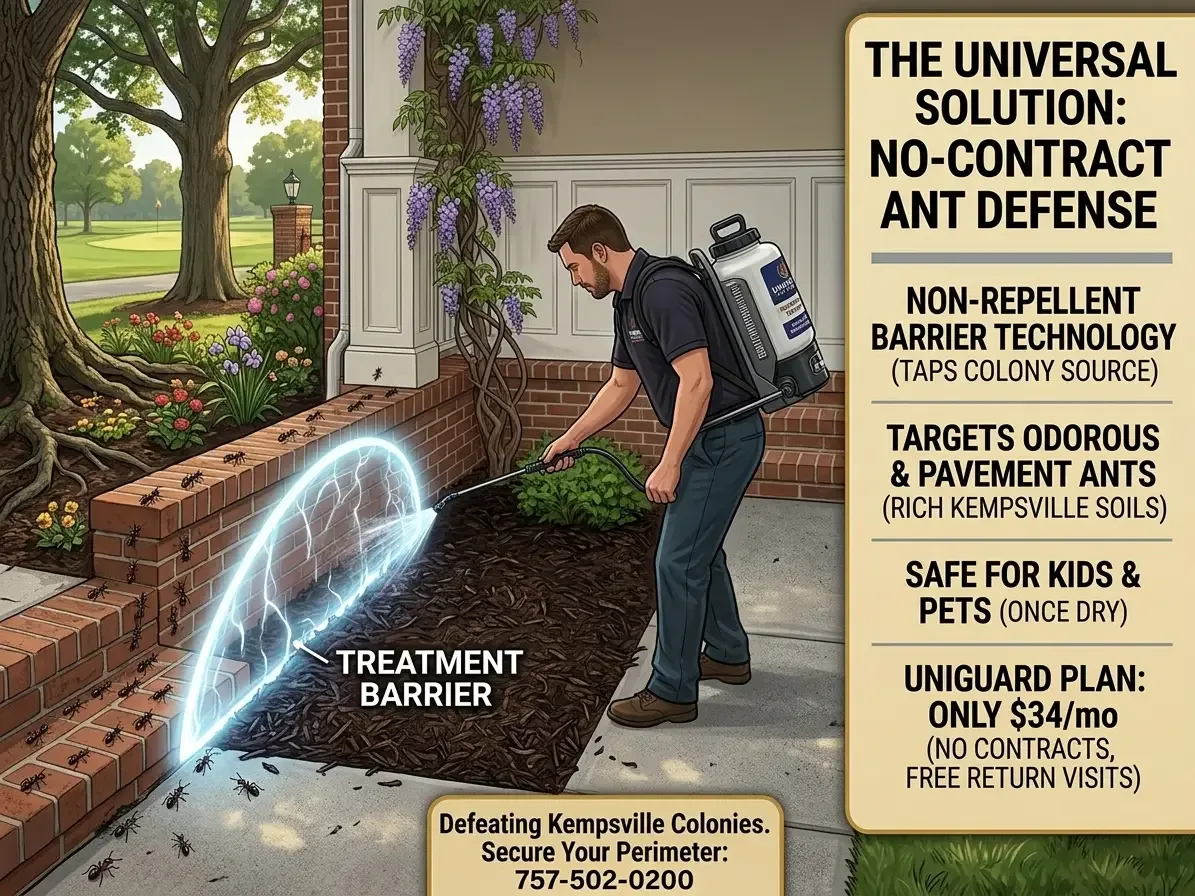
- Non-Repellent Sprays: Unlike standard sprays, ants can’t detect these, so they walk through them and spread the active ingredient throughout the colony. Always follow the label exactly; the “label is the law.”
Ant Control FAQ: Your Questions Answered
When you’re in the business of protecting homes, transparency is key to building trust. Here are the top five questions homeowners in Chesapeake and Hampton Roads ask when the “ant-phone” starts ringing.
1. How much does a one-time ant treatment cost?
For a standard quarterly interior and exterior treatment targeting common house ants, our quarterly service is $38/month. This usually includes a 30-to-90-day warranty. Keep in mind that a one-time “quick fix” October not address a deep-seated colony.
2. What is the cost for Carpenter Ant removal?
Because Carpenter Ants are wood-destroying insects that require specialized localized treatments or injections into wall voids, the price is higher than a standard ant service. What it comes to depends on the size of the infestation and how accessible the nest is, so it is quoted from the inspection rather than off a price list.
3. Is quarterly pest control a better value?
Absolutely. Just like a consistent sales follow-up process, consistency in pest control prevents “lost leads” (re-infestations). Our quarterly maintenance plan runs $38/month after an initial treatment. This ensures a protective barrier is maintained year-round.
4. Are these treatments safe for my kids and pets?
Safety is our “Product Knowledge” cornerstone. Modern professional treatments are designed to be applied in a way that minimizes exposure. When used according to the label by a trained professional, these products are highly effective against pests while remaining low-risk for your family. We always recommend keeping pets and children off treated surfaces until they are completely dry (usually 1–2 hours).
5. Why do I see more ants after a professional treatment?
Don’t panic—this means the “close” is working! Many professional baits and non-repellent sprays are designed to attract ants so they can carry the product back to the queen. Seeing increased activity for 3 to 7 days after a service is a sign that the colony is taking the bait.
Ready to protect your property? Whether you are dealing with a minor nuisance in the kitchen or a structural threat in the crawlspace, taking action now prevents a small problem from becoming a major liability.
When to Call in the Big Guns
If you’ve sealed the cracks, managed the moisture, and the “leads” are still coming in, it’s time to escalate. Large-scale infestations—especially those involving Carpenter Ants or nests deep within a crawlspace—often require professional-grade equipment and specialized knowledge of local soil and climate conditions.
Hampton Roads is a beautiful place to live—don’t let the ants think they’re your roommates.