Encapsulation gets sold hard in coastal Virginia, and for good reason — it solves a real and very common problem. But it is not the right answer for every house, and it is a poor answer for some. Here is the honest version.
What is the difference between a vented and an encapsulated crawl space?
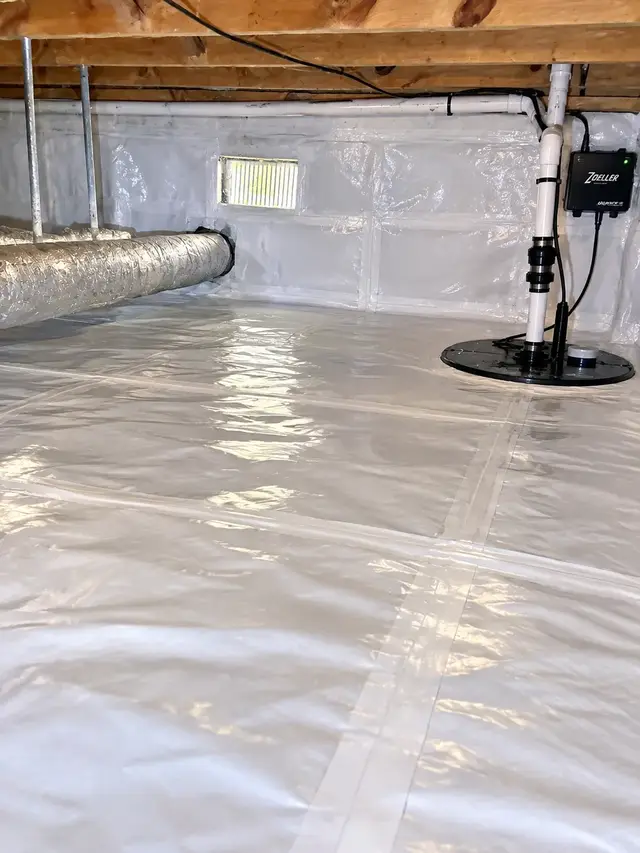
A vented crawl space has open foundation vents and relies on outdoor air to dry it. An encapsulated crawl space is sealed — vents closed, a heavy liner covering ground and walls, and humidity controlled mechanically instead of by outdoor air exchange.
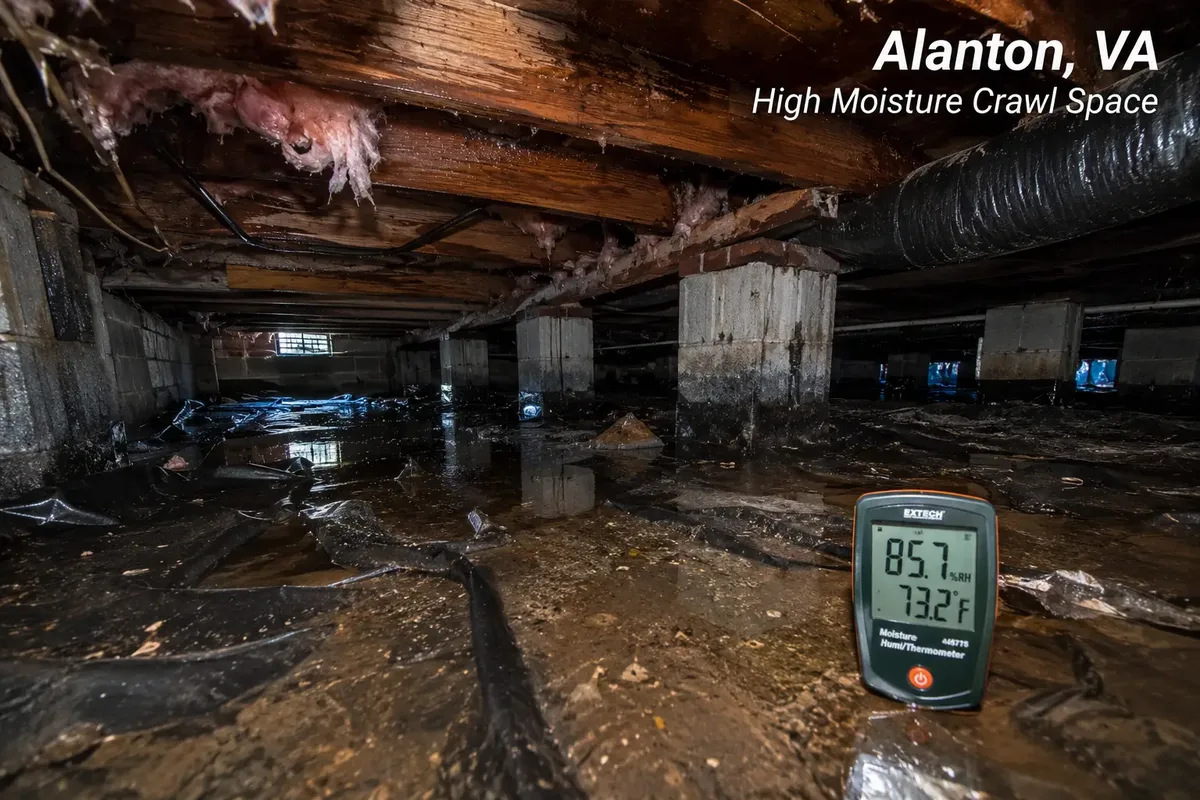
The vented approach is the older code-default assumption: move air through the space and moisture leaves with it. That logic works in a dry climate. In Hampton Roads, summer air often arrives with a dew point in the 70s, and when it meets a subfloor chilled by air conditioning above, it condenses. The vent becomes a moisture inlet rather than an outlet.
| Vented crawl space | Encapsulated crawl space | |
|---|---|---|
| Moisture control | Outdoor air exchange | Sealed envelope plus dehumidification or conditioned air |
| Summer performance here | Can import humid air and condense it on cool surfaces | Holds a stable relative humidity independent of outdoor air |
| Ground vapor | Thin or absent vapor barrier, frequently torn | Sealed liner up the foundation walls, seams taped |
| Insulation location | Batts between floor joists, prone to sagging when wet | Typically at the foundation wall, inside the sealed envelope |
| Termite inspection | Framing and foundation visible | Liner must leave an inspection gap at the sill, or activity can be concealed |
| Ongoing requirement | Keeping vents clear and the barrier intact | Maintaining the dehumidifier and the liner's integrity |
Is crawl space encapsulation worth it in Hampton Roads?
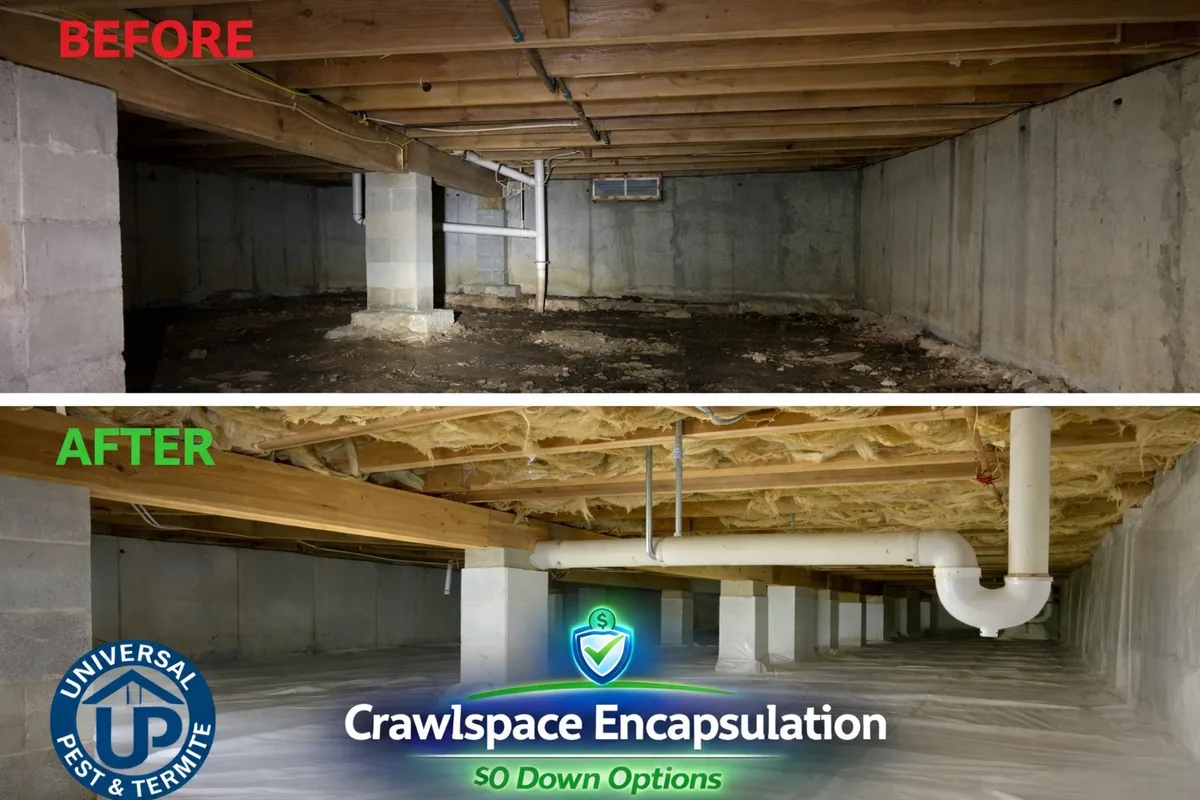
For most low-elevation homes in this region with a shallow water table and a persistent moisture problem, encapsulation is worth it — because ventilation cannot dry a space when the incoming air is more humid than the air already inside.
Encapsulation tends to pay off when several of these are true of your home:
- Crawl relative humidity stays high through the summer, or subfloor wood measures above roughly 20% moisture content.
- There is a recurring musty odor reaching the first floor.
- Fiberglass batts are sagging, falling, or visibly discolored.
- The house sits at low elevation near tidal water — the Lynnhaven and Elizabeth River corridors, Chic's Beach, Ocean View in Norfolk, or Western Branch in Chesapeake.
- Ductwork runs through the crawl and sweats in summer.
- There is a history of wood-decay fungi or repeated subterranean termite conducive-condition findings.
When is encapsulation not the right call?
Encapsulation manages water vapor. It does not manage liquid water, structural damage, or an active infestation — and sealing a crawl space before those are handled traps the problem under a liner where nobody looks at it again.
We will tell you to wait, or to spend the money elsewhere first, in these situations:
- There is bulk water intrusion. If water enters after rain, the fix is drainage — grading, downspout extensions, a French drain or sump. A liner over standing water is a pond with a lid.
- There is an unrepaired plumbing leak. Seal the crawl around a slow supply or drain leak and you have built a humid chamber with a continuous water source.
- Framing is already compromised. Joists, sills, or girders weakened by decay or termite damage need structural repair first. Access afterward is worse and more expensive.
- Active termites have not been addressed. Soil-applied termiticide is placed against the foundation, and a liner installed first complicates that work. Treat, then encapsulate — not the reverse.
- The crawl is too shallow to work in. Some clearances make a proper liner installation impossible; a sealed ground barrier plus dehumidification may be the realistic ceiling.
- The moisture problem is small and cheap to fix. Sometimes it really is a disconnected dryer vent, a missing downspout extension, or a torn barrier. Fix that, re-measure, and see where you stand.
Does encapsulation hide termites?
A liner run tight to the top of the foundation wall can conceal the mud tubes inspectors look for. Done correctly, the liner stops short of the sill plate, leaving a visible inspection strip so termite activity can still be detected.
This is the single most consequential detail in the whole job, and it is the one most often skipped. Subterranean termites reach a house by building shelter tubes up the foundation wall — that is the evidence a crawl space inspection is looking for. Cover the wall to the sill and you have removed the evidence without removing the termites.
Before any encapsulation we perform, the crawl gets inspected for active subterranean termite activity, and termite treatment is completed first if it is found. We have written separately about why the order of those two jobs matters.
What does a properly encapsulated crawl space require afterward?
A sealed crawl is not maintenance-free. Closing the vents removes the passive air exchange, so the code Virginia follows requires the space to get conditioned air or continuous mechanical exhaust — usually a dedicated dehumidifier.
- Humidity control that runs. A dehumidifier with a working condensate drain, checked seasonally.
- An intact liner. Plumbers, HVAC techs, and cable installers cut and crawl over liners. Re-seal after anyone works down there.
- Continued termite inspections. Encapsulation reduces the moisture that attracts termites; it does not make a house termite-proof.
- Insulation and ducts handled as one system. Wet fiberglass should be extracted rather than sealed in — Universal Insulation Doctor — and ductwork that has been sweating for years usually needs attention from Universal Duct Cleaning.
Frequently asked questions
Will encapsulation lower my energy bill?
It can help, because ductwork and floors are no longer surrounded by hot humid air in summer, and the floor above tends to feel less cold in winter. The size of the saving depends heavily on your duct location, insulation, and equipment, so we do not quote a percentage.
Is encapsulation required by code in Virginia?
No. Vented crawl spaces remain code-compliant. The code addresses what an unvented crawl space must include — a ground vapor retarder and either conditioned air or continuous mechanical exhaust — rather than requiring encapsulation in the first place.
Can I encapsulate part of a crawl space?
Partial liners generally underperform, because the untreated section keeps supplying moisture to the sealed one. Where a crawl is divided by a solid foundation wall into genuinely separate spaces, treating them independently can make sense.
How long does the liner last?
A reinforced liner installed and sealed correctly, and left undisturbed, lasts many years. The realistic failure mode is not wear — it is tradespeople cutting through it, so inspect after any work under the house.
How do I find out which one my house needs?
Measurement, not guesswork: crawl humidity, wood moisture content, the condition of the barrier and insulation, and whether termite activity is present. Universal Pest & Termite inspects crawl spaces across Virginia Beach, Chesapeake, Norfolk, Suffolk, Portsmouth, Hampton, Newport News, Williamsburg, Poquoson, and York County. Call (757) 502-0200.